
Breastfeeding genuinely can prevent pregnancy, but only under specific conditions, and only for a while. The Lactational Amenorrhoea Method (LAM) turns that biological window into a recognised contraceptive method, and when its three conditions are met it’s about 98% effective. The trouble is that plenty of women rely on “breastfeeding” loosely, miss one of the conditions, and are caught out. This explains exactly when LAM works, when it stops, and how to move on to fertility awareness as your cycles return.
How breastfeeding suppresses fertility
Frequent suckling raises prolactin and disrupts the hormonal pulses that trigger ovulation. No ovulation, no egg, no pregnancy. The effect is real, but it’s strongest when breastfeeding is frequent and exclusive, and it fades as feeds space out, solids are introduced, or your baby sleeps through the night. That’s why LAM isn’t simply “you can’t get pregnant while nursing”, a claim that catches many women out.
The three conditions, all of which must be true
LAM only delivers its 98% protection while all three of the Bellagio Consensus criteria hold at once:
| Condition | Detail |
|---|---|
| Your periods haven’t returned | You remain amenorrhoeic. Any bleeding after 56 days postpartum counts as a returning period. |
| You’re fully or nearly fully breastfeeding | On demand, day and night, with no long gaps and minimal supplementation or solids. |
| Your baby is under six months old | Protection drops after six months regardless of the other two. |
The moment any one of these fails, LAM’s protection falls and you need another method. A multicentre study coordinated through the Bellagio group, drawing on data across eight countries, found a six-month pregnancy rate under 2% when all three were maintained, which is the basis for the 98% figure.
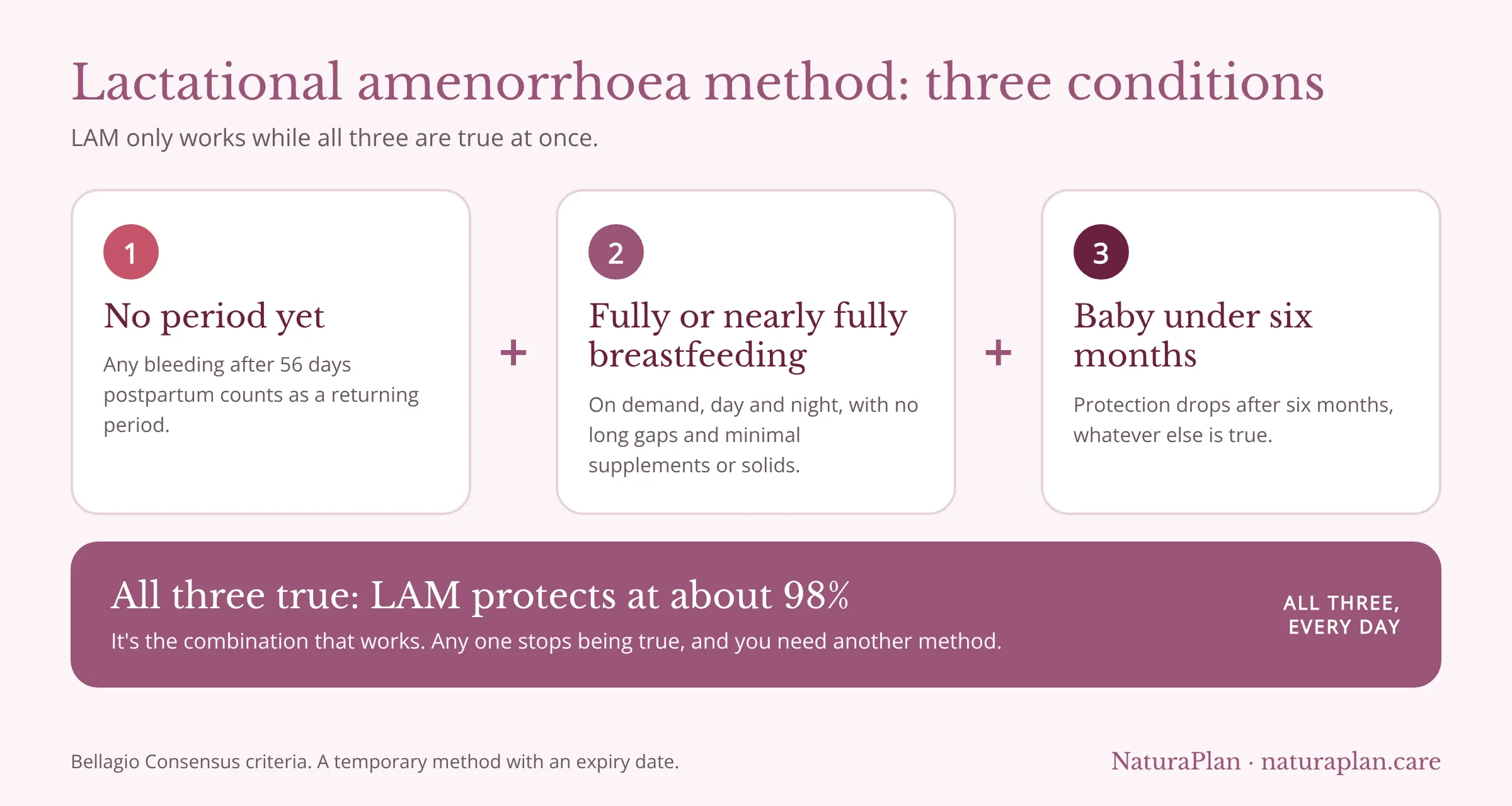 LAM protects only while all three conditions are true.
Where women get caught out
The common failure points are predictable: the first ovulation happens before your first postpartum period, so waiting for a bleed to signal “fertility’s back” can be a fortnight too late. For the full picture of how that timing plays out, and what to do about it, see our guide on whether you can get pregnant before your first period after birth. Introducing solids, dropping night feeds, or using a dummy that reduces suckling all quietly weaken the effect. And the six-month cutoff arrives whether or not you feel ready. LAM is effective, but it’s an expiring method, not an open-ended one.
Transitioning to fertility awareness
This is where LAM and natural family planning connect. As your cycles return, you shift from relying on breastfeeding to reading your own fertility signs. The postpartum transition is genuinely harder to chart than a settled cycle, since the first ovulation is unannounced and mucus patterns can be erratic, so the standard advice is to treat any fertile-quality mucus as fertile and use a barrier until a clear pattern establishes. Our guide to how natural family planning works covers the signs, and because postpartum cycles are often irregular at first, tracking an irregular cycle is the more relevant starting point during the changeover.
How to record signs before your period returns
One practical note, because it trips people up. Cycle tracking apps, NaturaPlan included, are built around a cycle, and a cycle needs a start date. While you’re still amenorrhoeic there isn’t one, so this window is a job for paper or a plain notes app rather than an app that wants to calculate a cycle day.
That isn’t a limitation worth worrying about. What you’re doing in these months is simple and doesn’t need software: a daily line recording what you observe, so that when the pattern changes you can recognise it as a change. Note the date, what you see and feel, and whether it differs from yesterday. A long stretch of sameness is your baseline. When variation appears, oestrogen is rising and the transition has started.
Once your first postpartum period arrives, you have a start date, and that’s the point to move your observations into an app that can interpret them.
Cycles back, or nearly?
From your first postpartum period onwards, NaturaPlan tracks your mucus and temperature and shows the pattern re-establishing rather than leaving you to guess. It’s a charting and education tool, not a contraceptive. Free for 14 days, no card needed, all data on your device. Try NaturaPlan free →
Used properly, LAM is one of the few genuinely effective ways to space pregnancies naturally in the early months. Just treat it as what it is: a real method with a clear expiry date, not a reason to stop paying attention. When any of the three conditions ends, have your next method ready, whether that’s fertility awareness or something else. Our overview of natural birth control methods lays out the options.
This article is for education, not medical advice. Discuss postpartum contraception with your midwife, GP, or lactation consultant. LAM does not protect against STIs.
Sources: Kennedy et al. / Bellagio Consensus, multicentre study of the Lactational Amenorrhoea Method, Contraception (1997); Van der Wijden & Manten, Cochrane Review (2015); WHO, Family Planning: A Global Handbook for Providers.