
Free tool
Ovulation and fertile window calculator
Estimate when you’re most likely to ovulate and which days are fertile. A good starting point if you’re trying to conceive.

Estimated ovulation
PeriodFertile windowOvulation
Your next three cycles
| Cycle | Fertile window | Ovulation | Next period |
|---|
Calendar estimates assume your cycle is the same every month. Your body’s actual signs are more reliable, and a calendar estimate is not contraception.
Runs entirely in your browser. Nothing you enter is sent or stored anywhere.
How it works
Enter your last period
And your usual cycle length.
See your fertile window
Ovulation and the days around it, marked on your cycle.
Plan the next three cycles
Dates you can come back to.
An estimate is a start. Your signs are the answer.
NaturaPlan reads your temperature and cervical mucus to confirm ovulation in your own cycle, then updates your fertile window each month.
Try it free for 14 days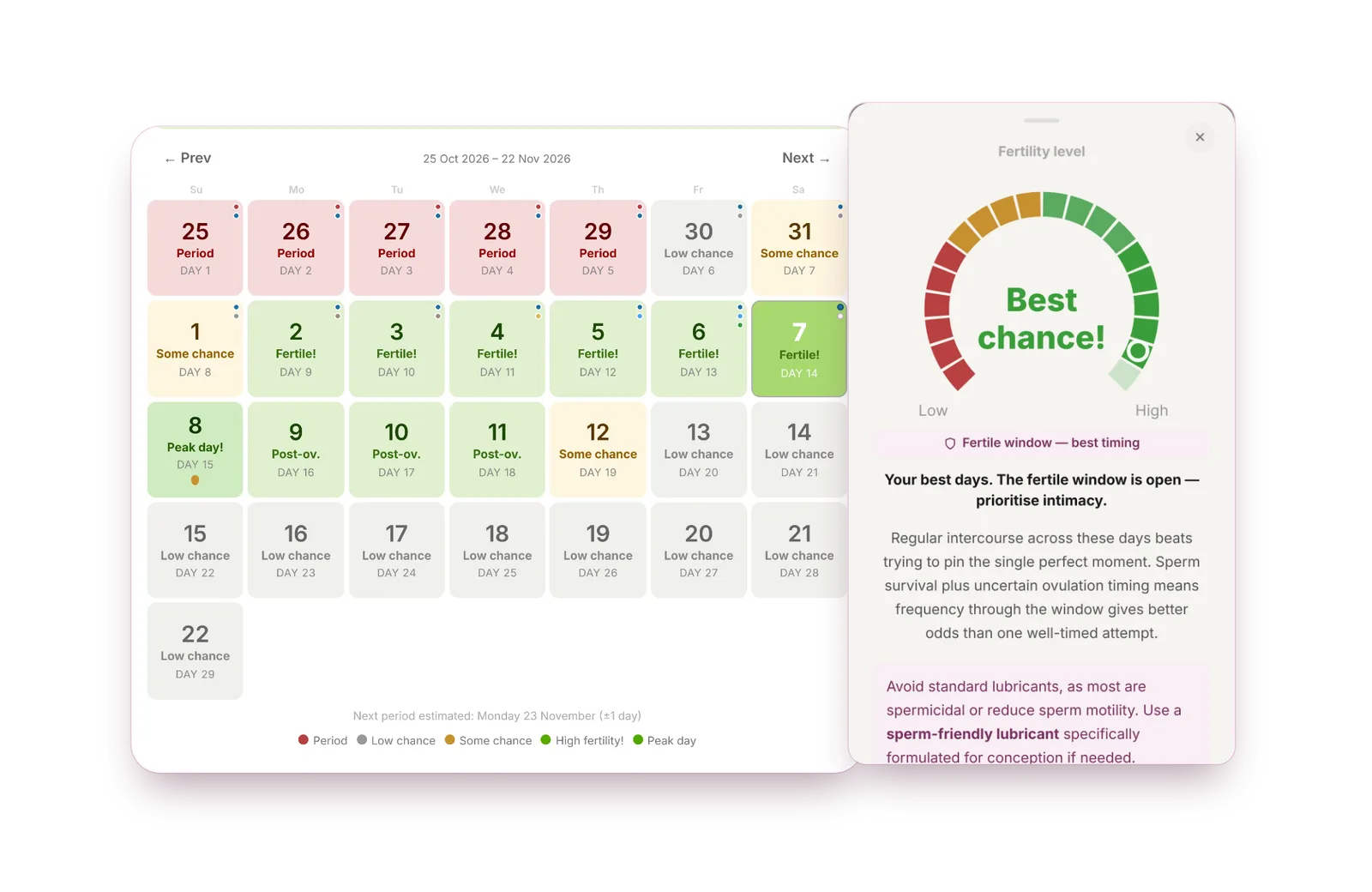
Trying to conceive
See your daily fertility score and the best days to try, with your partner on the same page.
Try it free for 14 daysAvoiding pregnancy naturally
Couples who time intimacy around the non-fertile days use the sympto-thermal method to know where they stand each day.
See how it worksCommon questions
How does this calculator estimate ovulation?
It counts back from your next expected period. Ovulation usually happens about 14 days before the next period starts, so a 28-day cycle ovulates around day 14 and a 32-day cycle around day 18. The fertile window is the five days before ovulation, plus the day itself and the day after.
Why is the fertile window longer than one day?
Sperm can survive for up to five days in fertile cervical mucus, while the egg survives about 12 to 24 hours. Intercourse in the five days before ovulation, or on the day, can lead to pregnancy.
Can I rely on this to avoid pregnancy?
No. A calendar estimate assumes your cycle and ovulation timing are the same every month, and they often are not. Stress, illness, travel and breastfeeding all move ovulation. Methods used to avoid pregnancy need to read your actual signs, which is what the sympto-thermal method does with temperature and cervical mucus.
What if my cycles are irregular?
The prediction becomes much less reliable. Use the cycle length calculator to see how much yours varies, and consider charting your temperature and mucus to confirm ovulation after it happens.
What is the luteal phase and does mine matter?
It’s the time between ovulation and your next period, usually 10 to 16 days. Setting it correctly improves the estimate. If you have confirmed ovulation on a chart, the luteal phase calculator can work out your own.