
Free tool
Cycle length and next period calculator
Add the first day of your last two or three periods. We’ll work out your average cycle, how much it varies, and when your next period is due.

Your next period is likely to start
Cycle lengthTypical 21 to 35 days
Predictions get less reliable the more your cycle varies. They show when a period is likely, not when you are fertile.
Runs entirely in your browser. Nothing you enter is sent or stored anywhere.
How it works
Add recent period dates
Three or more gives a useful average.
See your average and range
And how regular your cycle really is.
Know when to expect the next one
A predicted date, with a margin.
Stop guessing from averages
NaturaPlan learns from your own temperature and mucus each cycle, so you see ovulation confirmed rather than predicted.
Try it free for 14 days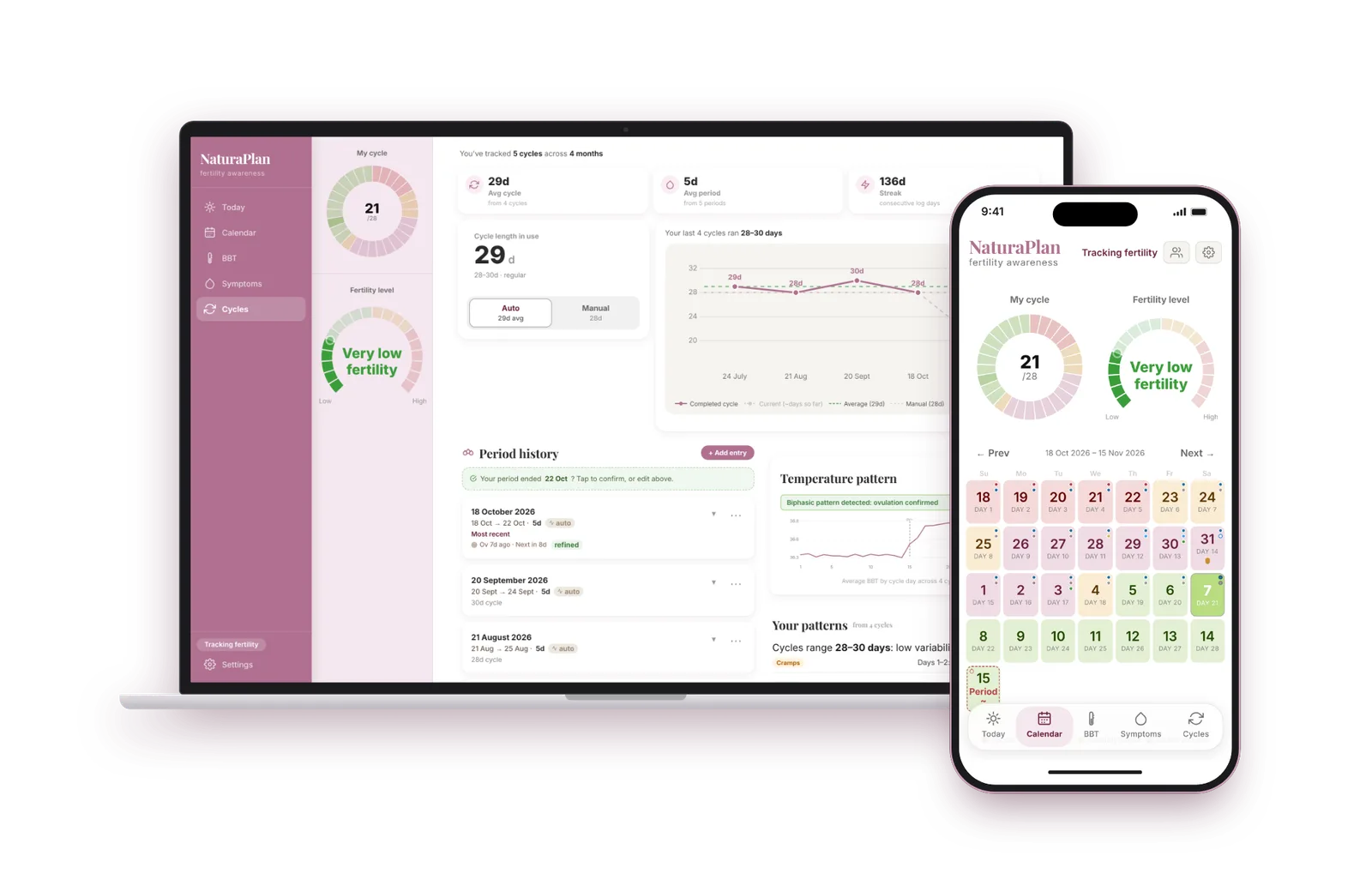
Chart every cycle
A calendar view with your phases, fertile window and what to expect next.
Try it free for 14 daysCommon questions
How is cycle length measured?
From the first day of one period to the day before the first day of the next. Count the first day of bleeding as day 1.
What is a normal cycle length?
Most adult cycles run 21 to 35 days, and the length can vary by a few days from month to month. Cycles that vary by more than about seven days, or that are regularly shorter than 21 or longer than 35 days, are worth raising with your GP.
How many periods do I need to enter?
Two dates give you one cycle length, and three or more let us show how regular you are. Up to your last six periods gives the best picture.
Can I use the prediction to avoid pregnancy?
No. Predicting your next period is not the same as knowing when you are fertile, because ovulation can move even when your period is regular. To avoid pregnancy naturally you need to track your signs each day.
Why does my cycle length change?
Stress, illness, travel, changes in sleep or weight, breastfeeding, coming off hormonal contraception and perimenopause can all change cycle length.