NaturaPlan for partners

It’s your job too.

Most cycle trackers assume one person (aka: the woman) owns the data and the decision. Family planning works better when you’re both reading from the same page. See where she’s at, understand what actually matters, and know where you stand each day of her cycle.

Start free Pricing

It takes two to tango.

Natural family planning isn’t something that happens to her while you wait for updates. The sympto-thermal method works best when both of you know what phase she’s in and what it means for the days ahead, whether the goal is avoiding pregnancy or trying to conceive.

The practical reason is simple. If you’re avoiding pregnancy, the decisions that matter happen during the fertile window, and they’re decisions for two people. If she’s the only one who knows the window has opened, you’re not planning together, you’re being informed.

You don’t need to log anything yourself. You just need to know how to read the picture she’s already tracking.

A couple holding each other close, foreheads together

The cycle, phase by phase

Six phases, and NaturaPlan colour-codes each one. This is what she’s likely experiencing, and what’s actually useful from you.

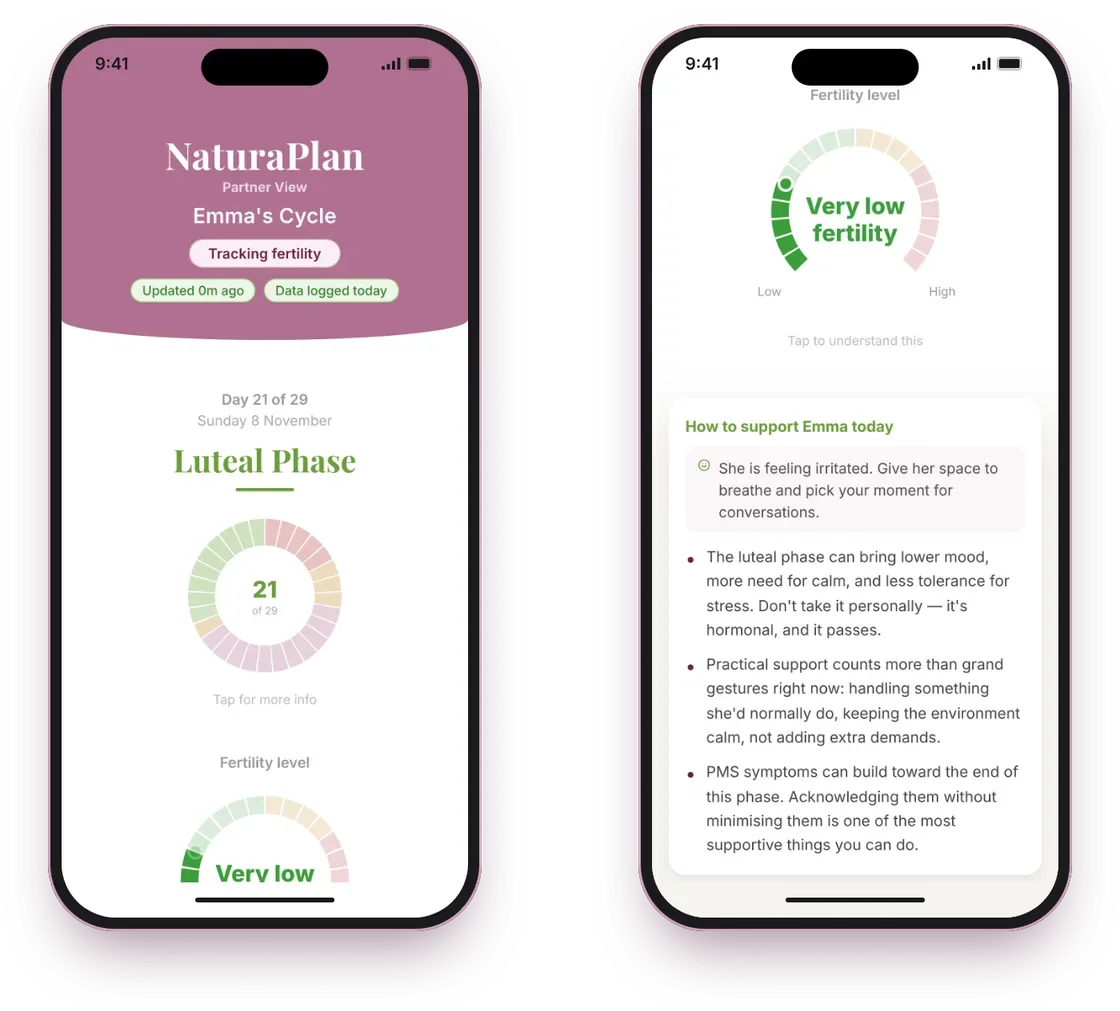
NaturaPlan’s Partner View: her cycle day and phase, her fertility level, and how to support her today
Not fertile

Period

Lower energy is normal here, and cramping, headaches, and disrupted sleep are common. Not a fertile phase in either mode.

What helps: take things off her plate rather than expecting much back. Warmth, iron-rich food, and not scheduling anything demanding. Don’t treat low energy as a mood to be fixed.

Low fertility

Early low-fertility days

The days straight after bleeding ends. Oestrogen is starting to climb, energy usually follows, and the app shows low fertility in Tracking mode.

What helps: nothing urgent is required. Good stretch for plans, exercise, and the conversations that need her to have the energy for them.

Still green

Low fertility, window approaching

Still green, but the window is getting closer. Her mucus starts changing before anything else does, which is the earliest signal either of you gets.

What helps: this is the time to have the conversation about how you’ll handle the fertile window, while it’s still hypothetical. Deciding in the moment is how couples end up making a decision neither of them wanted.

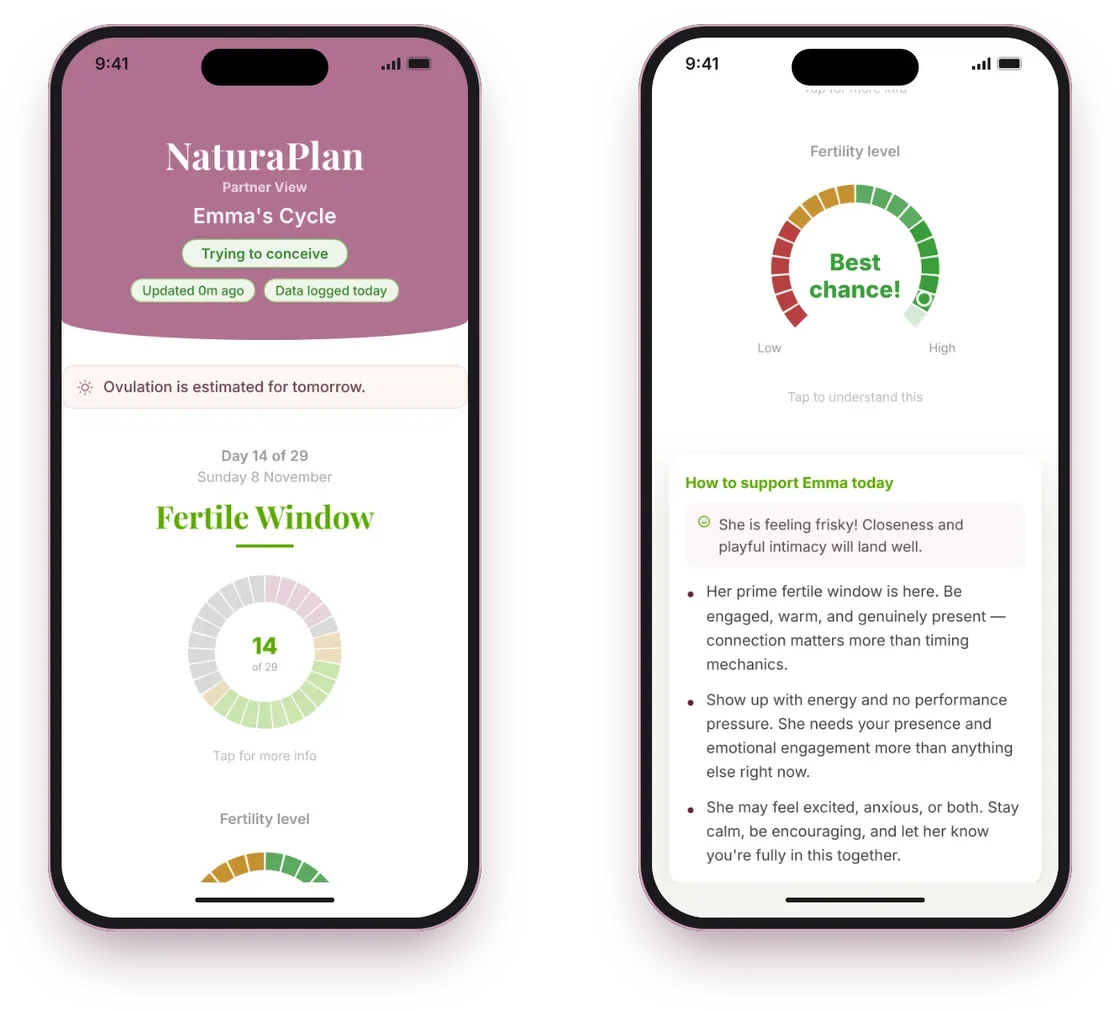
Fertile window open

Approaching ovulation

The fertile window has opened. The app moves to orange, then red. Sperm can survive several days inside the reproductive tract, which is why fertile days start well before ovulation itself. Her libido often climbs here, which is not a coincidence.

Avoiding pregnancy: this is when the plan you agreed on gets used. Barrier method, abstinence, or accepting the risk. Whichever you’ve chosen, it’s chosen already.

Trying to conceive: these days are the highest-priority ones of the cycle. Don’t save yourself for the single peak day.

Peak fertility

Ovulation

Peak fertility, and the highest Fertility Score of the cycle in both modes. Some women feel a one-sided ache around this point. The app’s score tells you both where things stand, so it isn’t a guessing game or a debate.

What helps: be clear, not coy. This is the day of the cycle where vague signals cause the most trouble in both directions.

Confirmed, then low

After ovulation

Once three consecutive temperature readings sit above her baseline, ovulation is confirmed and the fertile window is closed for that cycle. The app marks ovulation as confirmed and shows low fertility until her next period. Progesterone rises through this stretch, and for some women mood and energy dip in the last few days of it.

Avoiding pregnancy: under the method’s rules, confirmed ovulation is what marks the start of the infertile phase, rather than a guess.

Trying to conceive: the test-date countdown starts here. It’s the hardest part of the cycle for most couples, and there’s nothing left to do but wait.


If you’re trying to conceive

The most common mistake couples make is timing. Not too little effort, but effort concentrated on the wrong day. Clinical guidance is consistent that intercourse every day or every second day across the whole fertile window gives the best chance, rather than saving up for a single predicted peak.

That’s the practical value of tracking. The window is several days long, the app shows you all of them in advance, and you don’t have to reverse-engineer it from a calendar app’s guess.

If nothing has happened after several well-timed cycles, her charts are the most useful thing either of you can take to a GP or fertility specialist. Confirmed ovulation dates and luteal phase lengths across multiple cycles answer questions a single blood test can’t, and NaturaPlan exports the lot as a PDF.

NaturaPlan’s Partner View in Conceive mode: Fertile Window, Best chance, and how to support her today

Get your own view

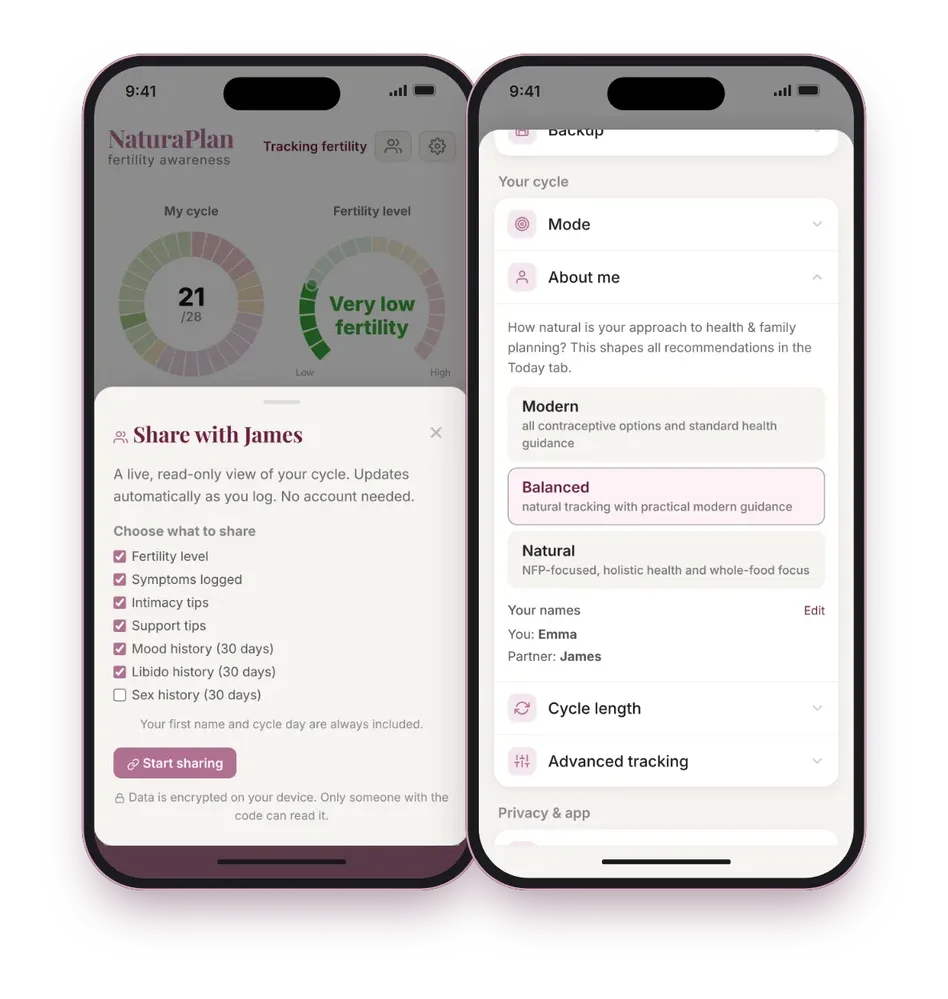
Ask her to generate a Partner View link from Settings. It opens in any browser on your phone, with no download and no account. You’ll see her current phase, her Fertility Score for the day, and a practical tip on how to support her, without needing access to her full temperature or symptom logs.

The daily tip is written for the phase she’s in and the mode you’re both planning in, so it’s specific. Not “be supportive”, but what tends to help in this particular week.

She can revoke or refresh the link any time. Nothing about this changes what stays private on her device. You can read the full feature list if you want to see everything the app does on her side.

NaturaPlan’s Share with partner screen, where she chooses what her partner sees

Questions partners actually ask

She says today is a red day. What does that mean?

She’s in the fertile window. In Tracking mode that means unprotected sex carries a real chance of pregnancy that day. In Conceive mode it means the opposite: this is a day worth prioritising.

How long is the fertile window?

Around six days in most cycles: roughly five days before ovulation plus the day itself. It’s that long because sperm survive for several days, not because the egg does. Its exact length and position shift cycle to cycle, which is the whole reason for tracking signs instead of counting days.

Do I need to log anything?

No. Partner View is read-only, and there’s nothing for you to install or sign up for. Your job is knowing what the numbers mean, not producing them.

What if she misses a day of logging?

The Fertility Score drops, and the app says so rather than hiding it. Missed days matter most in the run-up to ovulation. Treat a lower score as a reason to be more cautious in Tracking mode, not as a technicality.

Can I see her temperatures and symptoms?

Only if she chooses to share them. Partner View deliberately leaves raw data, symptom logs, and full cycle history out. She decides what’s on the link and can revoke it whenever she likes.

How effective is this really?

Typical-use effectiveness for the sympto-thermal method is approximately 98%, rising to 99.4% with perfect use. Perfect use means logging consistently and following the rules during the fertile window every cycle, which is where you come in. No method used by any couple is 100% effective. NaturaPlan is a cycle charting and education tool. It is not a contraceptive.

GET THE APP

Start planning your family naturally.

Free trial. No hormones. No card needed.

Get NaturaPlan