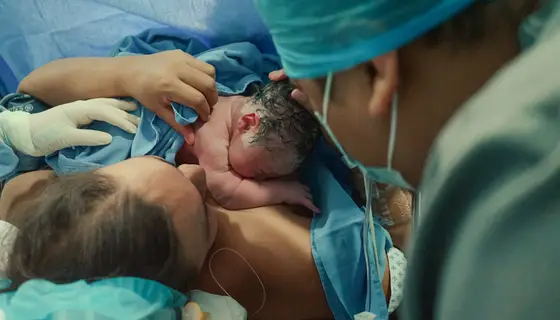
Two women feed their babies in what looks like the same way. One gets her period back at four months, the other at sixteen. Neither did anything wrong, and the difference isn’t random. It comes down to a hormone that responds to the pattern of feeding rather than the amount of milk.
The mechanism, briefly
Suckling at the breast triggers prolactin release. Prolactin suppresses the pulsatile release of gonadotropin-releasing hormone from the hypothalamus, which in turn keeps FSH and LH low. Without those, follicles don’t mature, oestrogen stays flat, and there’s nothing to ovulate.
The important word is pulsatile. The hypothalamus doesn’t release GnRH in a steady stream; it releases it in bursts, and the timing of those bursts is what drives the whole cycle. Prolactin disrupts the rhythm rather than switching anything off, which is why the return of fertility is gradual and often untidy rather than a clean on-off event.
This also explains why the suppression is fragile. Prolactin has a short half-life. Levels rise with a feed and fall between feeds, so what maintains suppression is frequency, not volume. A woman producing a great deal of milk across four long feeds may see her cycle return earlier than a woman producing less across twelve short ones.
Why night feeds matter more than day feeds
Prolactin has a circadian rhythm, peaking overnight. A feed at two in the morning produces a bigger prolactin response than the same feed at two in the afternoon.
The other factor is the longest gap. The single strongest predictor of cycles returning isn’t how many feeds happen in a day, it’s the length of the longest interval between them. A woman feeding ten times across the day but sleeping a seven-hour stretch overnight has a longer suppression-free window than a woman feeding eight times spread evenly around the clock.
Which is why the thing that most often precedes a first period is the baby starting to sleep through. It usually gets attributed to the baby’s age. The mechanism is the gap.
Rough timelines, and why the range is so wide
Without breastfeeding, cycles typically return within six to eight weeks, and ovulation can occur earlier than most people expect, in some cases from around three and a half to four weeks after birth.
With exclusive breastfeeding, the median is much later, commonly somewhere between six and fourteen months, but the spread around that median is enormous. A minority of women exclusively breastfeeding around the clock will still cycle at three months. Others won’t see a period until well after weaning.
That variation is real and it isn’t explained by feeding pattern alone. Individual sensitivity to prolactin differs, as do body composition, nutritional status and genetics. Two women with identical feeding routines can genuinely get different answers, which is the honest version of this and the reason no timeline should be treated as a plan.
What tends to bring cycles back
Night weaning is the big one, for the reasons above. Introducing solids reduces the number and intensity of feeds, often more than parents realise, because a baby who has eaten still comes to the breast but takes less and stimulates less.
Dummies and bottles substitute non-nutritive sucking that would otherwise happen at the breast. Returning to work and expressing instead of feeding directly is a common trigger, because a pump generally produces a smaller prolactin response than a baby does. Any separation that stretches the intervals will do the same.
Illness, either yours or the baby’s, can shift the pattern for a week and shift the hormonal picture with it. Significant weight loss or a sustained drop in energy intake can also lift the suppression, which surprises people, but ovulation is metabolically expensive and the body is responsive to whether the resources are there.
The first cycles are usually not normal cycles
When cycles do come back, the early ones are frequently anovulatory, meaning a bleed occurs without an egg being released. Others ovulate but with a short luteal phase, sometimes under ten days, which is generally too short to sustain an implantation.
For anyone trying to conceive again, this is worth knowing. The return of bleeding isn’t the same as the return of fertility in any full sense, and it may take several cycles before the luteal phase lengthens out. That’s ordinary and it usually resolves on its own.
For anyone avoiding pregnancy, the reverse point matters far more, and it’s the single most important sentence in this article. Ovulation happens before bleeding. Your first postpartum period is a lagging indicator. By the time it arrives, you have already been fertile for around two weeks, which is why conceiving before a first postpartum period is entirely possible and happens more often than most people assume.
Where LAM fits
The Lactational Amenorrhoea Method turns this biology into something usable, but only under three conditions held together: the baby is under six months, you have had no return of bleeding after 56 days postpartum, and you are fully or nearly fully breastfeeding with no long gaps. Meet all three and it’s a genuinely effective method. Break one and it isn’t a method at all.
Our guide to using LAM properly covers where the assumptions usually go wrong, and it’s worth reading before relying on it rather than afterwards.
The gap LAM leaves is the transition. Once any of the three conditions fails, you need something else in place, and the something else has to start before your period arrives rather than after.
When to see a GP
Bleeding that returns while you’re exclusively breastfeeding a baby under two months, particularly if it’s heavy, is worth checking rather than assuming it’s a period. Retained products and other postpartum causes are more likely at that stage.
No period at all twelve months after fully weaning warrants investigation. Thyroid dysfunction is common postpartum, with postpartum thyroiditis affecting a meaningful share of women in the first year, and its symptoms of fatigue, low mood and hair loss get attributed to new motherhood almost automatically. Severe postpartum haemorrhage in rare cases affects pituitary function and can prevent cycles returning.
Cycles that come back extremely heavy or painful compared with before pregnancy, or bleeding between cycles once they’re established, are also worth raising.
Watching for it rather than waiting for it
The practical answer to all of this is to stop treating the first period as the starting gun. Cervical mucus changes as oestrogen begins to rise, which is your earliest available signal that the system is waking up, and it appears well before any bleeding.
Before that first period there’s no cycle to count from, so cycle apps have nothing to anchor to and this window belongs on paper. It doesn’t need to be elaborate. A dated line each day recording what you observe is enough, and a long stretch of sameness is exactly the baseline that makes the eventual change obvious.
Once bleeding starts, you have a cycle day, and that’s when NaturaPlan takes over: mucus and temperature logged together, with the early erratic cycles interpreted rather than guessed at.
Read the pattern as it re-establishes
NaturaPlan is free, requires no account, and keeps everything on your device. From your first postpartum period onwards, track your signs and watch your cycle settle.
This article is for educational purposes and does not constitute medical advice. Speak to a midwife, lactation consultant or GP about your own situation.