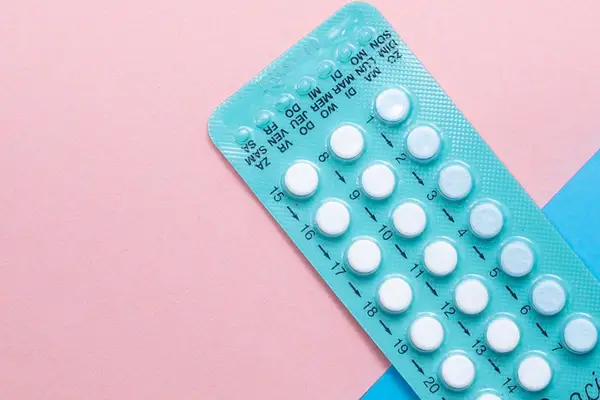
The combined pill has been prescribed to hundreds of millions of women since 1960, and for many it’s effective, convenient, and the right choice. This post isn’t an argument against it. It’s an honest account of the trade-offs that tend to get skipped in a ten-minute appointment: what the pill does beyond preventing pregnancy, which side effects the evidence actually supports, and what you can reasonably expect if you decide to come off it.
Some of these effects are well documented in large studies. Others are supported by smaller or more preliminary research, and I’ve flagged which is which as we go, because the difference matters and overstating it helps no one.
How the pill works, briefly
Combined oral contraceptives deliver synthetic oestrogen and progestin, which suppress ovulation, thin the uterine lining, and thicken cervical mucus. No ovulation, no egg, no pregnancy. That’s the mechanism, and it’s genuinely effective. The point worth holding onto is that the pill works by switching off your natural cycle, so most of its side effects flow from that same fact: you’re running on synthetic hormones instead of your own.
The well-documented side effects
Start with mood, because it’s both the most common complaint and, for a long time, the most dismissed. A 2016 Danish study tracking more than one million women, published in JAMA Psychiatry, found that hormonal contraceptive users were more likely to be subsequently prescribed an antidepressant or diagnosed with depression, with the association strongest in adolescents. That’s population-level data, not proof it will affect any given woman, but it’s a large, well-conducted study, and it moved the conversation from “it’s all in your head” to a documented signal.
Blood clot risk is the most serious and best-established effect. Combined pills raise the risk of venous thromboembolism several-fold over baseline. The absolute risk remains low for most healthy women, but it’s real, it’s why the pill isn’t prescribed to smokers over 35 or women with certain clotting histories, and it’s the reason any new leg pain or breathlessness on the pill warrants prompt attention.
Breakthrough bleeding, headaches, breast tenderness, and nausea are common in the early months and often settle. These are clinically recognised and usually manageable.
Nutrient depletion
This is where the evidence is real but more measured, so the language should be too. A 2013 review in the European Review for Medical and Pharmacological Sciences concluded that oral contraceptive use is associated with lower levels of several nutrients, including folate, vitamins B2, B6, B12, C and E, and the minerals magnesium, selenium and zinc. Some evidence suggests these depletions are worth attention, particularly for B vitamins and for women planning to conceive soon after stopping, since folate status matters in early pregnancy.
What the evidence doesn’t clearly establish is that every woman on the pill needs to supplement, or that these changes cause noticeable symptoms in most users. The honest framing is: the pill can shift your nutrient status, it’s sensible to eat well and worth discussing folate with your doctor if you’re coming off it to try to conceive, and beyond that the practical significance varies from woman to woman.
Libido and longer-term effects
The pill raises sex hormone-binding globulin (SHBG), a protein that mops up free testosterone. Since testosterone drives libido, this is the plausible mechanism behind the reduced desire many women report. A 2006 study in The Journal of Sexual Medicine found that pill users had markedly higher SHBG than never-users, and raised the question of whether it fully normalises after stopping. That study was in women already experiencing sexual dysfunction, so it can’t be generalised to everyone, and the long-term reversibility question remains genuinely open rather than settled. Treat it as a documented mechanism and a reasonable concern, not a certainty that applies to all users.
What happens when you come off
Fertility can return quickly, but your natural cycle often takes three to six months to fully re-establish, and the transition can bring its own symptoms: irregular cycles, changes in skin, shifts in mood as your own hormones take back over. None of this is failure; it’s your body recalibrating. We walk through the timeline in our guide to what to expect in your first six cycles off the pill.
Coming off and want to understand your cycle?
NaturaPlan helps you read your natural signs as they return, so you can see your cycle re-establish in real time. It’s a charting and education tool, not a contraceptive. Free for 14 days, no card needed, everything on your device. Try NaturaPlan free →
The natural alternative, if you want one
If part of your reason for reading this is that you’d rather not be on synthetic hormones at all, there’s a genuinely effective hormone-free route. Fertility awareness, done well, prevents pregnancy by tracking your cycle rather than suppressing it. Our overview of natural birth control methods ranks the options by evidence, and if the whole approach is new, what natural family planning is is the place to start. Neither is a reason to feel pressured off the pill; they’re simply there if you want them.
Talk to your doctor
This is educational, not medical advice. If you’re weighing whether to start, stay on, or come off the pill, that’s a conversation to have with a clinician who knows your history, your risk factors, and what you’re trying to achieve. The aim here isn’t to talk you out of anything. It’s to make sure the trade-offs are on the table, so whatever you choose, you choose it with the full picture.
Two ways to go further:
📱 Try NaturaPlan free — track your cycle as it returns, privately, in your browser.
📖 Get The Natural Cycle — our complete hormone-free family planning guide, free with your email.
This article is for education, not medical advice, and does not describe every possible effect of hormonal contraception. Do not start or stop any medication based on it. Discuss your options with a qualified clinician.
Sources: Skovlund et al., JAMA Psychiatry (2016); Palmery et al., European Review for Medical and Pharmacological Sciences (2013); Panzer et al., The Journal of Sexual Medicine (2006); NHS, Combined Pill.