
The Sympto-Thermal Method (STM) is the combination of two fertility signs, basal body temperature and cervical mucus, into a single, cross-confirming framework for identifying the fertile window. It is the most extensively researched natural family planning method in the peer-reviewed literature, and it’s the method NaturaPlan teaches.
This guide explains how the method works, what the research shows, and how to apply it in practice.
The Core Logic
The STM is built around a straightforward insight: two independent biological signs, produced by two separate hormonal processes, can be read together to confirm fertility status more reliably than either sign alone.
Cervical mucus reflects rising oestrogen before ovulation. It changes from dry or sticky through creamy to the slippery, stretchy egg-white consistency that signals peak fertility is imminent. Mucus tells you the fertile window is opening, before ovulation. Full guide to cervical mucus.
Basal body temperature reflects rising progesterone after ovulation. A sustained temperature rise of 0.2–0.5°C above the pre-ovulatory baseline, maintained for three consecutive days, confirms ovulation has occurred. BBT tells you the fertile window has closed, after ovulation. Full guide to BBT.
Together: mucus predicts, BBT confirms. When both signs agree, with mucus drying up and temperature rising, confidence in post-ovulatory safety is high. When they disagree, the method defaults to the more fertile interpretation.
The Three Phases of the STM
The STM divides each cycle into three phases based on the observed signs:
Phase One: Pre-ovulatory relatively infertile phase. The early dry days of the cycle, before any fertile mucus appears. For women with consistent cycles, these days can be identified as low-risk using a combination of past cycle length data and the absence of changing mucus. During the learning phase, Phase One should be treated conservatively with backup contraception.
Phase Two: The fertile phase. Begins with the first sign of changing mucus, any transition from dry or sticky toward creamy or wetter, and continues until three consecutive elevated temperatures above the coverline, combined with mucus returned to dry or sticky. All days in Phase Two are treated as potentially fertile.
Phase Three: Post-ovulatory confirmed infertile phase. Begins on the evening of the third consecutive temperature above the coverline, provided mucus has also dried up. This is the most reliable infertile period of the cycle, and the most valuable for women using the STM for contraception.
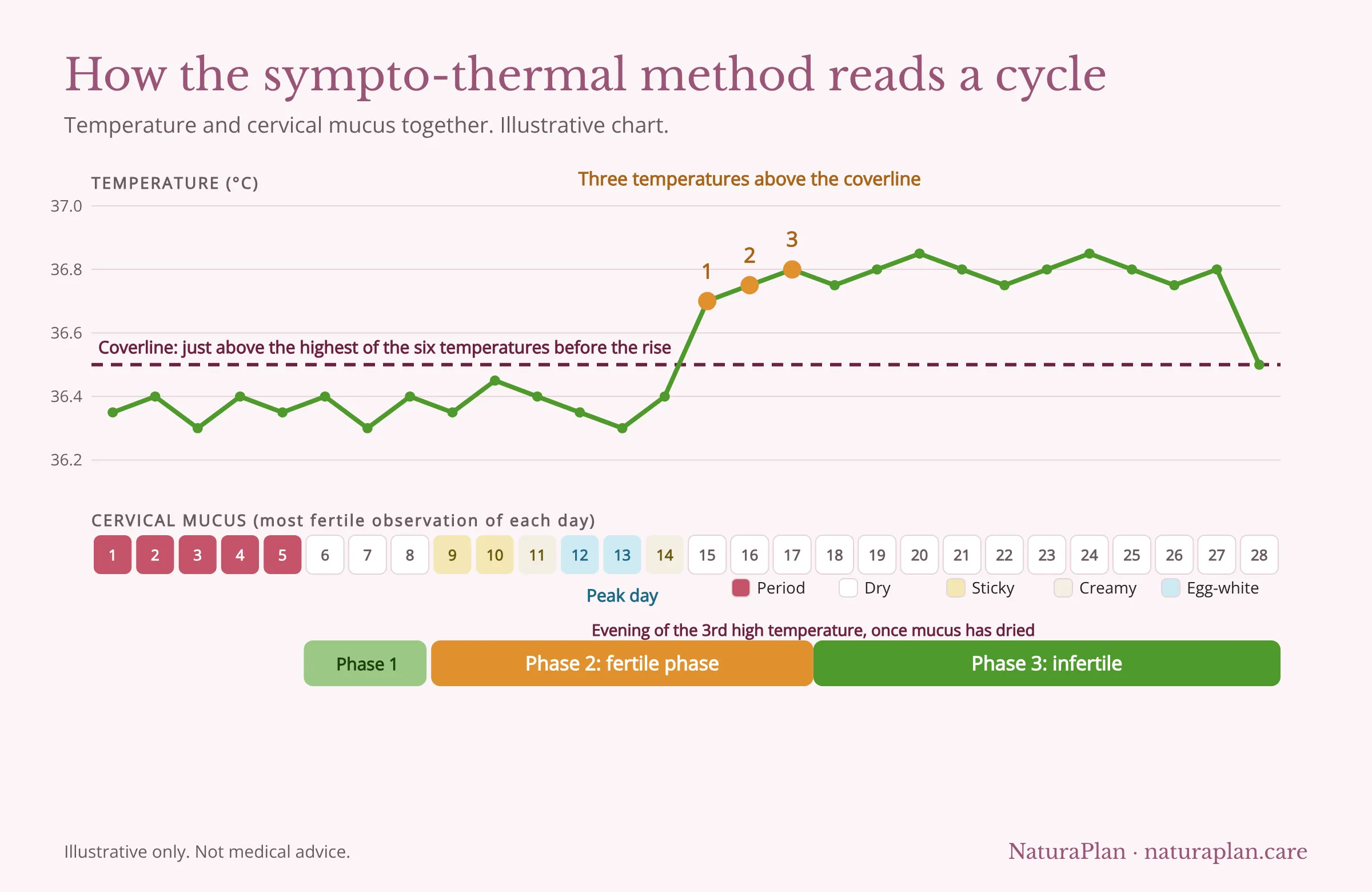 Temperature and mucus together mark the fertile phase and the confirmed infertile phase.
What the Research Shows
The definitive effectiveness study of the STM was conducted by Frank-Herrmann et al., published in Human Reproduction in 2007. The study followed 900 women across 17,638 menstrual cycles.
Results:
- Perfect use effectiveness: 99.4%, comparable to the combined oral contraceptive pill
- Typical use effectiveness: ~98%, with proper instruction
- The method was effective across a range of cycle lengths, including women with irregular cycles
A wide-ranging review of fertility awareness methods by Planned Parenthood notes that two-sign methods like the STM consistently outperform single-sign methods (mucus or temperature alone) and calendar methods in effectiveness research.
Is natural family planning actually reliable? A full breakdown of the evidence.
How to Apply the STM
Daily practice:
- Take your BBT every morning before rising and log it in NaturaPlan
- Observe and log cervical mucus at least three times daily, recording the most fertile observation
- Note any disrupted temperature readings (illness, poor sleep, alcohol)
- Let NaturaPlan’s Fertility Score combine the data into a daily estimate from 0 to 100
Post-ovulatory confirmation: Once you observe three consecutive temperatures above your coverline and mucus has returned to dry or sticky, post-ovulatory Phase Three is confirmed. Under the method’s rules, the evening of the third elevated temperature is where the post-ovulatory infertile phase begins.
The pre-ovulatory phase: This is where most users find the method most challenging, and where most careful attention is needed. Any day with changing mucus is treated as the beginning of the fertile phase. Your first three cycles covers this in detail, including how to approach the pre-ovulatory phase during the learning period.
The STM vs Other Methods
| STM | Calendar only | Billings (mucus only) | |
|---|---|---|---|
| Perfect use | 99.4% | ~91% | ~97–99% |
| Typical use | ~98% | ~76% | ~78–88% |
| Equipment | BBT thermometer | None | None |
| Irregular cycles | ✅ Yes | ❌ No | ✅ Partial |
| Learning curve | 2–3 cycles | Minimal | 2–4 cycles + instructor |
NaturaPlan and the STM
NaturaPlan teaches and charts the Sympto-Thermal Method. Every feature is built around the method:
- BBT log with sparkline chart: daily temperature entry, automatic coverline calculation, phase-shift identification
- Mucus quick-tap logger: one tap to log Dry / Sticky / Creamy / Egg-white
- Fertility Score: combines cycle day, BBT trend, and mucus data into a single 0–100 estimate
- Partner view: shares phase, Fertility Score, and mood summary without exposing raw data
- Cycle report: end-of-cycle summary of average temps, mucus patterns, confirmed ovulation day, and luteal length
Sources
- Frank-Herrmann P et al. (2007). The effectiveness of a fertility awareness based method to avoid pregnancy. Human Reproduction, 22(5), 1310–1319. https://academic.oup.com/humrep/article/22/5/1310/2914315
- Planned Parenthood. (2023). Fertility awareness. https://www.plannedparenthood.org/learn/birth-control/fertility-awareness
- Trussell J. (2011). Contraceptive failure in the United States. Contraception, 83(5), 397–404. https://www.ncbi.nlm.nih.gov/pmc/articles/PMC3638209/
- NHS. (2023). Natural family planning. https://www.nhs.uk/conditions/contraception/natural-family-planning/
NaturaPlan is built around the STM
BBT log, mucus tracker, Fertility Score, partner view, cycle report. Monthly or annual plans. No card needed to start.
Try NaturaPlan Free →. NaturaPlan is a charting and education tool, not a contraceptive.