
Of the two primary fertility signs used in natural family planning, cervical mucus is the one that most surprises women who are new to fertility awareness. Not because it is complicated (it is actually quite simple once you know what you are looking for) but because no one told them it was useful.
Cervical mucus changes throughout the menstrual cycle in response to oestrogen and progesterone. Those changes are visible, readable, and learnable within one to two cycles of attentive observation. They tell you when the fertile window is opening, days before ovulation, in a way that basal body temperature and calendar tracking alone cannot.
Why Cervical Mucus Changes Across Your Cycle
The cervix produces mucus continuously throughout the reproductive years. Its character (texture, quantity, colour, and stretchiness) changes dramatically across the cycle in response to changing hormone levels.
Rising oestrogen before ovulation stimulates the cervical crypts to produce increasing quantities of mucus with a specific structure: long, parallel channels that guide and nourish sperm, allowing survival of three to five days. Without this fertile mucus, sperm cannot survive in the acidic vaginal environment for more than a few hours.
After ovulation, rising progesterone causes the cervix to produce a thick, impermeable mucus plug. This closes off the cervical opening and creates an environment hostile to sperm, protecting a potential implantation from further sperm entry and signalling that the fertile window has closed.
Healthline’s overview of cervical mucus provides a useful supplement to this explanation, including a visual guide to the four stages.
The Four Stages of Cervical Mucus
The transition from post-period dryness to peak fertility follows a characteristic pattern. Learning to identify these four stages is the core skill of mucus-based fertility awareness.
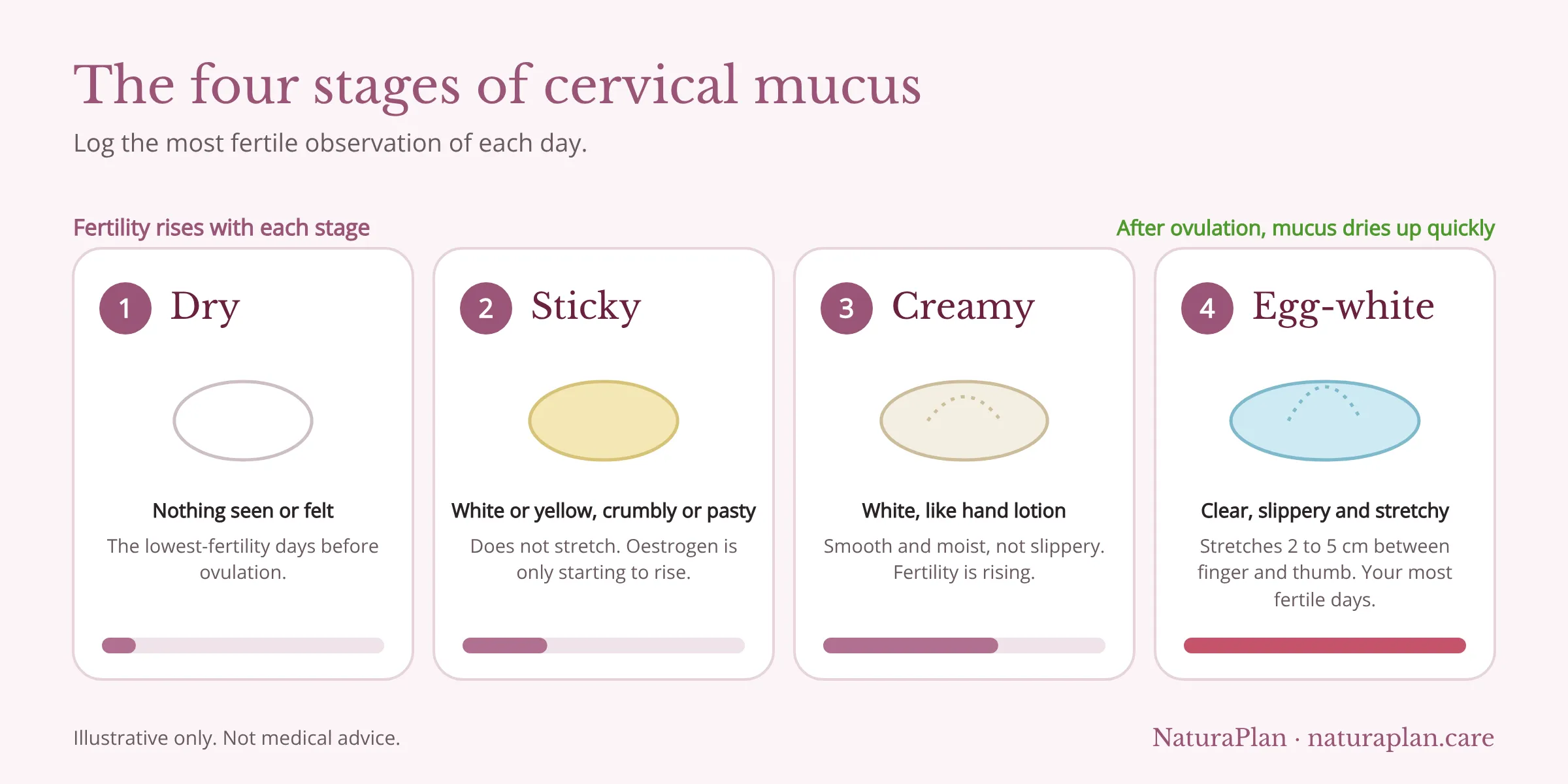 The four stages, from lowest to highest fertility.
Stage 1: Dry / Nothing. Nothing visible or felt at the vaginal opening. The sensation internally is dry. These are the lowest-fertility days of the pre-ovulatory phase. Oestrogen has not yet risen enough to stimulate mucus production.
Stage 2: Sticky. White or yellowish, opaque. Crumbly, pasty, or tacky in texture. Does not stretch between the fingers. This mucus does not provide a hospitable environment for sperm survival, but its appearance signals that oestrogen is beginning to rise and the fertile window is approaching.
Stage 3: Creamy. White or cream-coloured, resembling hand lotion. Smooth, moist, and slightly stretchy, but not slippery. The vaginal sensation is notably wetter than during the dry or sticky stages. Creamy mucus indicates that oestrogen is rising meaningfully and that the fertile window is opening.
Stage 4: Egg-white (EWCM). Clear or slightly streaked. Highly slippery and elastic, stretching two to five centimetres between the finger and thumb without breaking. The resemblance to raw egg white is precise. This is the most fertile type of mucus: it nourishes and transports sperm with maximum efficiency, creating conditions in which sperm can survive for three to five days. The appearance of egg-white mucus is the signal that ovulation is imminent.
After ovulation: Mucus dries up rapidly as progesterone takes over. The abrupt return to dry or sticky marks the close of the fertile window. This drying is one of the most distinctive and reliable features of the post-ovulatory phase.
Peak Day
The last day of egg-white cervical mucus is called the Peak Day. It is identified retrospectively. A woman knows it was her Peak Day when the following day she notices that the slippery, stretchy quality has disappeared.
Ovulation typically occurs within 24 to 48 hours of Peak Day, most commonly on Peak Day itself or the day after. Peak Day is the single most useful reference point for both avoiding and achieving pregnancy:
- Avoiding pregnancy: Peak Day and the surrounding days represent the highest-risk period. Under the method’s rules, the post-ovulatory infertile phase begins only after four days post-Peak combined with three elevated temperatures.
- Achieving pregnancy: Intercourse on Peak Day and the two days prior represents optimal timing. Timing intercourse for conception.
How to Observe Cervical Mucus
Observation is straightforward once the habit is established. Check at least three times daily: morning, midday, and evening.
Method 1 (most common): After using the toilet, observe what is on the tissue after wiping. Note the appearance (colour, opacity) and feel (texture, stretchiness).
Method 2: Check at the vaginal opening with a clean finger, noting what is visible and how it feels between finger and thumb.
Always record the most fertile observation of the day. If egg-white mucus appears in the morning but only sticky is present by evening, the morning’s observation takes precedence. Fertile mucus always wins.
Log in NaturaPlan using the quick-tap symptom logger: Dry / Sticky / Creamy / Egg-white. One tap. The logged observation feeds into your Fertility Score immediately.
What Can Interfere With Observation
Several factors can make mucus observation more difficult:
- Sexual arousal produces its own lubricative fluid, which is different from cervical mucus but can be confused with fertile mucus immediately after arousal
- Semen from previous intercourse can mask mucus for up to 24 hours
- Vaginal infections alter discharge in ways that interfere with mucus pattern recognition
- Antihistamines and some antidepressants dry mucus secretions
- Spotting around ovulation can briefly obscure mucus observation
These situations call for extra conservatism. When in doubt, treat the day as fertile.
Combining Mucus With BBT
Mucus observation predicts the approach of ovulation. BBT confirms that ovulation has occurred. Together, they form the Sympto-Thermal Method, the most thoroughly researched non-hormonal fertility awareness approach, with a perfect-use effectiveness rate of 99.4%.
Learn more about the Billings Ovulation Method, a mucus-only approach for women who prefer not to use a thermometer.
Sources
- Healthline. (2023). Cervical mucus: stages, tracking, and more. https://www.healthline.com/health/womens-health/cervical-mucus
- Cleveland Clinic. (2023). Cervical mucus. https://my.clevelandclinic.org/health/articles/22681-cervical-mucus
- NHS. (2023). Natural family planning. https://www.nhs.uk/conditions/contraception/natural-family-planning/
- Frank-Herrmann P et al. (2007). Human Reproduction, 22(5), 1310–1319. https://academic.oup.com/humrep/article/22/5/1310/2914315
Want to go deeper?
Get The Natural Cycle, our free complete guide to hormone-free family planning including a full chapter on reading your fertility signs.