
Ask most people how many days a month a woman can get pregnant and you will get answers ranging from “just one day” to “basically any time.” Neither is right, and the gap between them is where most unintended pregnancies and most conception frustrations occur.
The fertile window is biologically defined, scientifically understood, and entirely learnable. It also sits at the centre of how natural family planning works: identify the window accurately and you know precisely which days matter. This post explains exactly how long it is, what determines it, and why the conventional wisdom about ovulation timing is wrong for most women.
The Two Numbers That Define the Fertile Window
The fertile window is determined by two biological facts:
Egg viability: 12–24 hours. Once released from the follicle at ovulation, the egg is viable for fertilisation for approximately 12 to 24 hours. After that window, it dissolves. There is no second chance in that cycle.
Sperm survival: 3–5 days. Sperm deposited in the reproductive tract under fertile cervical mucus conditions can survive and remain capable of fertilisation for three to five days. Some research suggests up to six days in optimal conditions, though three to four days is the more commonly cited practical figure.
The fertile window is therefore primarily determined by sperm survival, not egg viability. Intercourse five days before ovulation can result in pregnancy if those sperm survive to meet the egg at the moment of release.
This produces a counterintuitive but important conclusion: the days before ovulation are often more important for conception than ovulation day itself. A 2000 study in the BMJ by Wilcox et al. found that the highest probability of conception occurred from intercourse two days before ovulation, when sperm are already present and waiting as the egg is released, rather than on ovulation day itself, when the egg’s viability may already be declining.
For women trying to avoid pregnancy, this means that the pre-ovulatory days require the most caution. For women trying to conceive, it means timing the days before ovulation is at least as important as timing ovulation day itself.
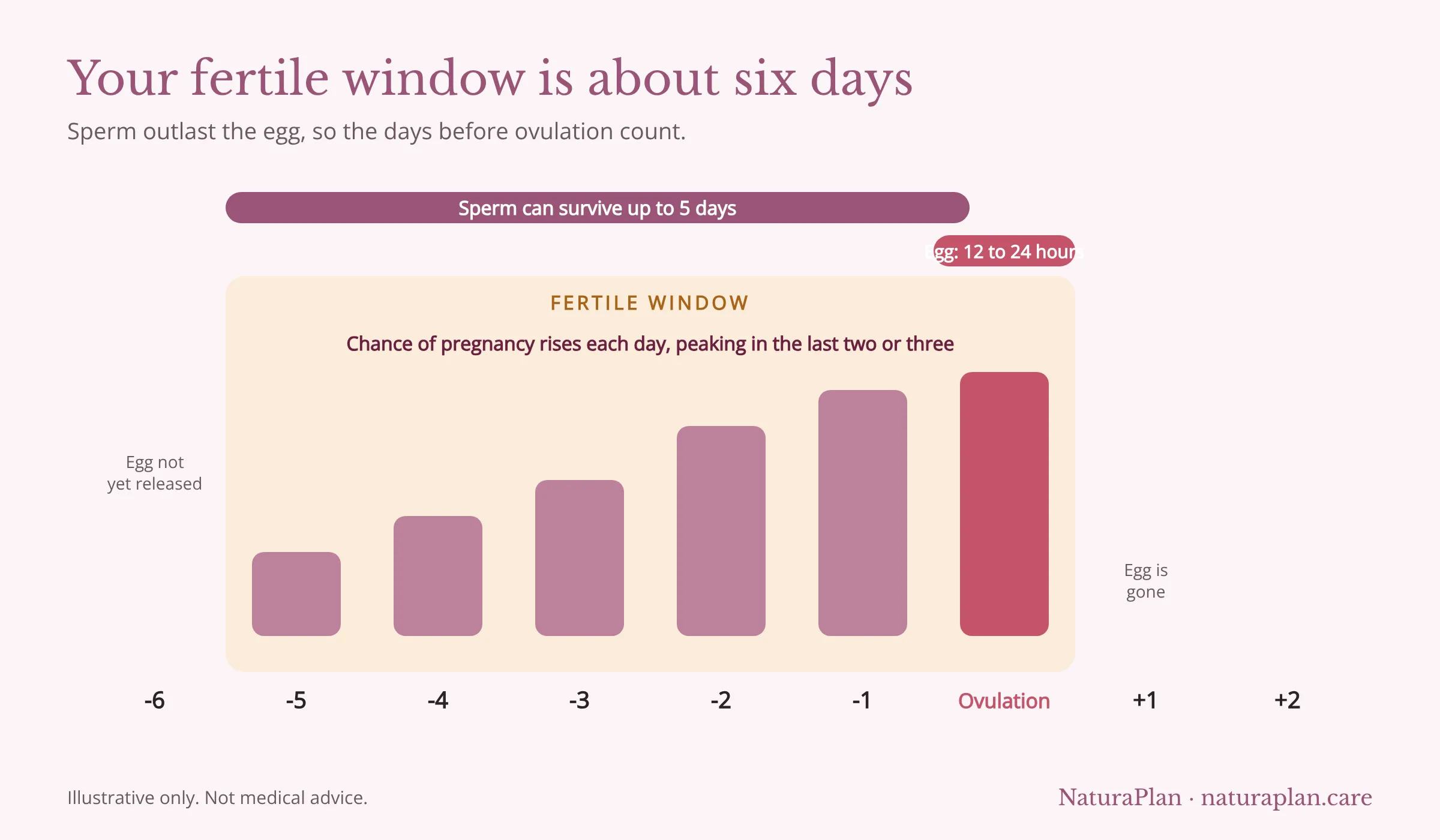 The fertile window: five days before ovulation plus the day itself.
Why the Practical Fertile Window Is Longer Than the Biology
Taking sperm survival into account, the core biological fertile window is approximately six days: the five days before ovulation and ovulation day itself.
However, natural family planning methods apply a conservative window that extends slightly beyond this, typically seven to nine days. There are two reasons:
1. Ovulation timing is not perfectly predictable. Even with basal body temperature tracking and cervical mucus observation, the exact day of ovulation can shift by a day or more due to stress, illness, travel, or natural cycle variation. A conservative buffer accounts for this.
2. The fertile window must be identified in real time. The opening of the fertile window is recognised from changing cervical mucus, the transition from dry or sticky to creamy, then egg-white. This takes time to observe and interpret, particularly in the learning phase of fertility awareness.
In practice, most NFP methods treat the fertile window as approximately eight days per cycle. The Sympto-Thermal Method applies the most precise window definition, using both mucus and BBT to identify its start and confirm its end.
The Day 14 Ovulation Myth
The assumption that ovulation occurs on Day 14 is one of the most consequential errors in reproductive health education.
The figure comes from a calculation based on a 28-day cycle with a 14-day luteal phase. If those two figures are both accurate for a particular woman in a particular cycle, ovulation on Day 14 follows mathematically. But neither figure is reliably accurate for most women most of the time.
The luteal phase, from ovulation to the next period, is relatively consistent: typically 12 to 14 days. But the follicular phase, from Day 1 through to ovulation, is the variable part. It can range from 10 days to over 20 days, and it shifts in response to stress, illness, travel, and natural hormonal variation.
The result: ovulation timing in healthy women varies considerably.
- A woman with a consistent 32-day cycle ovulates around Day 18, four days later than the Day 14 assumption
- A woman with a 24-day cycle ovulates around Day 10, four days earlier
- The same woman may ovulate on Day 12 in one cycle and Day 17 in the next
A calendar-only method that assumes Day 14 will be wrong for a large proportion of users in a large proportion of cycles. Natural family planning methods that use actual body signs rather than fixed-day calculations are substantially more reliable.
How NaturaPlan Estimates Your Fertile Window
NaturaPlan combines three data sources to identify the fertile window with increasing accuracy as data accumulates:
Calendar position — your cycle day relative to your average cycle length, updated across your last six cycles. This provides the framework.
Cervical mucus — the transition from dry or sticky to creamy to egg-white signals the opening of the fertile window in real time. This is the predictive sign.
Basal body temperature — the sustained rise after ovulation confirms that the fertile window has closed. This is the confirmatory sign.
The Fertility Score combines all three into a single daily estimate from 0 to 100. In Tracking mode, a high score means high estimated fertility. In Conceive mode, a high score means optimal conception opportunity.
Sources
- Wilcox AJ et al. (2000). The timing of the “fertile window” in the menstrual cycle: day specific estimates from a prospective study. BMJ, 321(7271), 1259–1262. https://www.bmj.com/content/321/7271/1259
- Dunson DB et al. (2002). Day-specific probabilities of clinical pregnancy based on two prospective studies with imperfect measures of ovulation. Human Reproduction, 14(7), 1835–1839.
- NHS. (2023). Natural family planning. https://www.nhs.uk/contraception/methods-of-contraception/natural-family-planning/
Want to go deeper?
Get The Natural Cycle, our free complete guide to hormone-free family planning. 140 pages, plain English, evidence-based.