
Most women know their menstrual cycle as a period that arrives once a month. What happens in between, the other 23-odd days, tends to go unexamined, largely invisible, something the body does quietly in the background.
This invisibility is worth challenging. The menstrual cycle is not a period with some uneventful days attached. It is a sophisticated, four-phase hormonal process that shapes energy, mood, cognition, libido, skin, digestion, and immune function throughout the month. Understanding it is not just useful for family planning. It is foundational to understanding your own health.
This post covers the four phases of the menstrual cycle in plain English: what is happening hormonally in each phase, how long each one lasts, and what it means for how you feel and function.
Why the “28-Day Cycle” Is Mostly a Myth
Before we look at the phases, it is worth dispensing with the most persistent myth in menstrual health: that a normal cycle is 28 days long and that ovulation happens on Day 14.
Both figures are population averages derived from early reproductive research conducted on limited samples. In reality, cycle length in healthy women ranges from approximately 24 to 35 days, and varies from cycle to cycle within the same individual by three to five days. A 2019 study published in npj Digital Medicine, using data from 612,613 menstrual cycles, found that fewer than 13 percent of cycles were exactly 28 days long, and that fewer than 30 percent of women ovulated on Day 14 even in 28-day cycles.
This matters practically: a method that assumes Day 14 ovulation will be wrong for the majority of users. Understanding your actual fertile window begins with understanding which phase you are actually in.
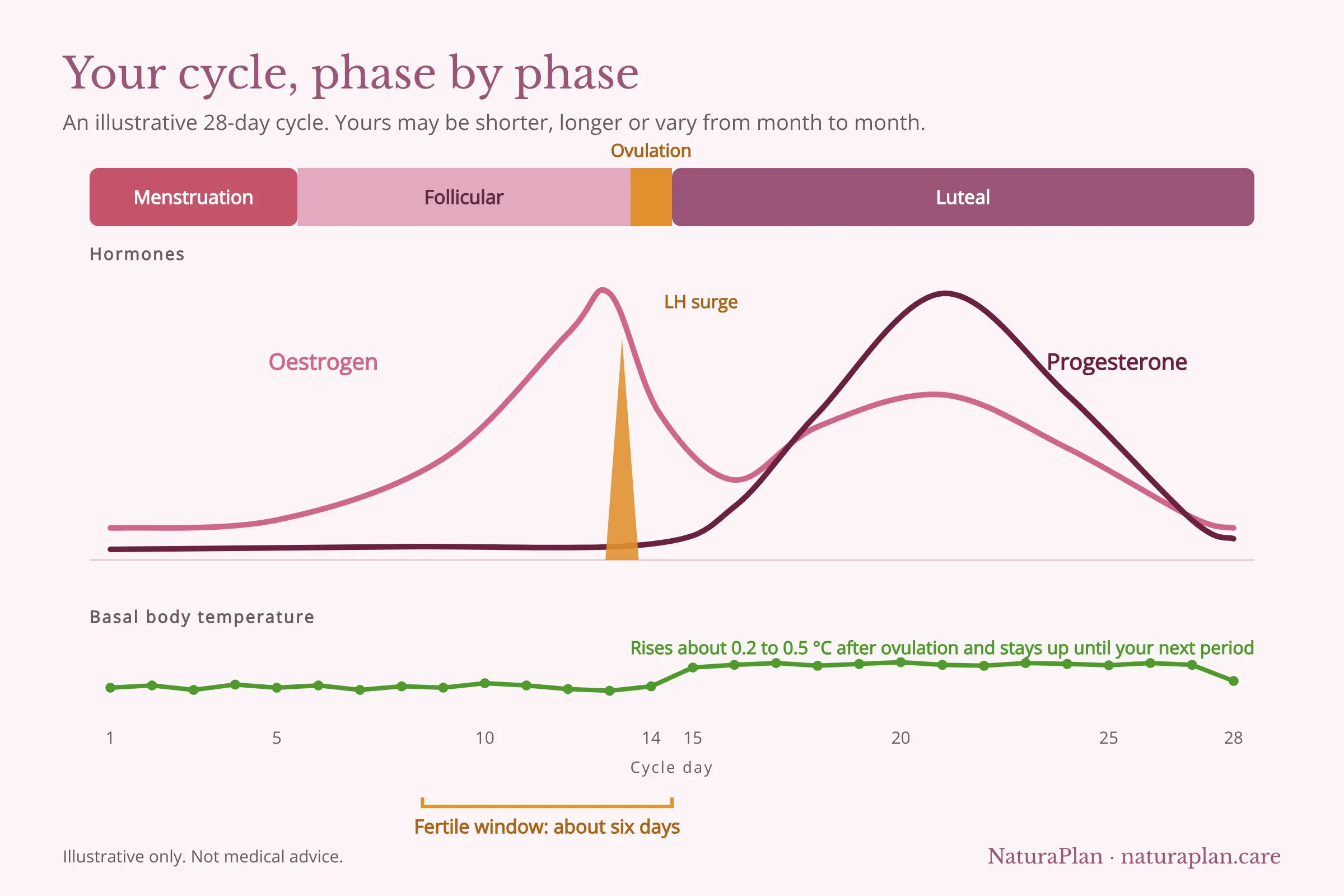 The four phases at a glance, on an illustrative 28-day cycle. Yours may differ.
Phase 1: Menstruation (Days 1–5, approximately)
By convention, Day 1 of your cycle is the first day of bleeding. Menstruation marks the end of the previous cycle and the beginning of a new one.
What is happening: The thickened uterine lining, built up in the luteal phase in anticipation of a fertilised egg, has not received the hormonal signal to stay. Oestrogen and progesterone drop sharply, triggering the contraction and shedding of the endometrium. This is the cause of cramping: prostaglandins, hormone-like compounds produced in the endometrium, stimulate uterine muscle contractions. Their intensity explains why period pain varies so dramatically between women and between cycles.
Hormones: Both oestrogen and progesterone are at their lowest. Follicle-stimulating hormone (FSH) begins to rise, stimulating a cohort of follicles in the ovaries to begin developing.
Duration: Typically 3–7 days. Average blood loss is approximately 30–80ml per cycle; more than 80ml is considered heavy bleeding and warrants investigation.
Fertility: Very low. Conception during menstruation is extremely unlikely, but sperm survive up to five days, so intercourse in the final days of a longer period can occasionally carry a small risk. Learn more about the fertile window.
Energy and mood: Physical energy is typically at its lowest. Fatigue, reduced social motivation, and a preference for rest are common and physiologically normal. The drop in oestrogen and progesterone reduces serotonin availability, which contributes to emotional sensitivity in some women.
What helps: Iron-rich foods (the body is losing iron through blood loss), warmth, magnesium (reduces cramping), and reduced demands on physical and social energy. For more on eating in alignment with this phase, see our cycle syncing guide.
Phase 2: The Follicular Phase (Days 1–13, approximately)
The follicular phase runs concurrently with and then beyond menstruation. It is the first major hormonal arc of the cycle, the build-up toward ovulation.
What is happening: FSH stimulates a cohort of follicles in the ovaries to develop. Each follicle contains an immature egg. Over approximately one to two weeks, one follicle becomes dominant, growing larger, outcompeting the others, and producing increasing quantities of oestrogen. The other follicles regress.
Rising oestrogen simultaneously rebuilds the uterine lining (thickening the endometrium in preparation for potential implantation) and stimulates cervical mucus production that will eventually become fertile in character. Understanding cervical mucus is one of the most important skills in fertility awareness.
Hormones: FSH drives follicle development; oestrogen rises steadily as the dominant follicle grows.
Duration: This is the variable phase. In a 28-day cycle it lasts approximately 13 days; in a 35-day cycle it may last 20 days. This variability is why ovulation is unpredictable from calendar counting alone.
Fertility: Low in the early follicular days, building toward the fertile window as the phase progresses. From approximately Day 7 onward (earlier in short cycles), sperm survival means intercourse can carry increasing risk.
Energy and mood: Rising oestrogen is associated with improved verbal fluency, working memory, and social motivation in research studies. Most women describe this as their most energetic, outgoing, and creatively engaged phase. The Cleveland Clinic describes oestrogen as the “feel-good” hormone of the cycle, and the follicular phase is where its effects are most clearly felt.
Phase 3: Ovulation (Day 14, approximately, but variable)
Ovulation is a single event: the release of a mature egg from the dominant follicle, triggered by a surge in luteinising hormone (LH).
What is happening: As oestrogen peaks, it triggers the hypothalamus to release a surge of GnRH, which causes the pituitary to release a large pulse of LH. This LH surge occurs approximately 24–36 hours before the egg is released. The mature follicle ruptures, releasing the egg into the fallopian tube, where it will remain viable for approximately 12–24 hours.
The Mayo Clinic notes that basal body temperature rises measurably after ovulation, by 0.2–0.5°C, due to the thermogenic effect of progesterone. This temperature shift, detectable with a basal body thermometer, confirms that ovulation has occurred.
Hormones: Peak oestrogen, an LH surge, and a brief testosterone peak that does not occur at any other point in the cycle.
Duration: The ovulatory event itself is brief, a matter of hours. The fertile window surrounding it spans approximately six days (the five days before and ovulation day itself), determined primarily by sperm survival.
Fertility: Peak. This is the highest-risk or highest-opportunity point of the cycle depending on your goal. For more on the fertile window: How long is your fertile window?
Energy and mood: Many women describe feeling most capable, communicative, and socially confident around ovulation, which maps directly onto the hormonal environment of peak oestrogen and briefly elevated testosterone. Some women notice mittelschmerz (a brief, mild twinge on one side of the lower abdomen), a normal sign of follicle rupture.
Phase 4: The Luteal Phase (Days 15–28, approximately)
The luteal phase is the second half of the cycle, from ovulation to the next period. It is the most consistent phase in length, typically 12–14 days regardless of overall cycle length.
What is happening: After the egg is released, the empty follicle transforms into the corpus luteum, a temporary glandular structure that produces progesterone. Progesterone’s primary role is to maintain the thickened uterine lining, creating a hospitable environment for a fertilised egg to implant.
If fertilisation occurs, the embryo produces hCG (human chorionic gonadotropin), the hormone detected by pregnancy tests, which signals the corpus luteum to keep producing progesterone. If fertilisation does not occur, the corpus luteum breaks down after approximately 12–14 days, progesterone falls, and menstruation begins.
Hormones: Progesterone dominates. Oestrogen has a secondary rise mid-luteal phase, then both drop if no pregnancy occurs.
Duration: 12–14 days in most women. A luteal phase shorter than 10 days may indicate insufficient progesterone and is worth discussing with a doctor. Learn what cycle patterns may signal about your health.
Fertility: Very low from the third day after confirmed ovulation onward. The luteal phase is the most predictable part of the cycle, and once ovulation is confirmed the method treats it as the infertile phase.
Energy and mood: Progesterone has a calming, slightly sedating effect through its conversion to the neurosteroid allopregnolone. Many women find the luteal phase better suited to focused, detail-oriented work than social or high-stimulation activities. In the late luteal phase, as progesterone declines before menstruation, PMS symptoms (bloating, breast tenderness, mood changes, food cravings) are driven by this hormonal drop combined with reduced serotonin availability.
Metabolic rate increases by approximately 100–300 calories per day in the luteal phase. The increased appetite and carbohydrate cravings many women experience in the week before their period are real, physiological responses, not a failure of willpower.
Why Understanding Your Phases Matters
The four phases are not just a biological curiosity. They are the framework that makes natural family planning possible, and the foundation of every feature in NaturaPlan.
When you open NaturaPlan and see your colour-coded calendar, each colour represents a phase:
- Rose/pink for the menstrual phase
- Green for low-fertility follicular and luteal days
- Amber for approaching or leaving the fertile window
- Red for the fertile window
Understanding what each phase means hormonally transforms the calendar from a collection of coloured squares into a genuinely informative picture of what your body is doing.
Further reading in this series:
- How long is your fertile window?
- Basal body temperature: the complete guide
- Cervical mucus: what it means and how to track it
- Cycle syncing: eating and exercising with your hormones
Sources
- Bull JR et al. (2019). Real-world menstrual cycle characteristics of more than 600,000 menstrual cycles. npj Digital Medicine, 2, 83. https://www.nature.com/articles/s41746-019-0152-7
- Cleveland Clinic. (2023). Menstrual cycle. https://my.clevelandclinic.org/health/articles/10132-menstrual-cycle
- Mayo Clinic. (2023). Basal body temperature for natural family planning. https://www.mayoclinic.org/tests-procedures/basal-body-temperature/about/pac-20393026
- American College of Obstetricians and Gynaecologists. (2015). Menstruation in girls and adolescents: using the menstrual cycle as a vital sign. https://www.acog.org/clinical/clinical-guidance/committee-opinion/articles/2015/12/menstruation-in-girls-and-adolescents
Try NaturaPlan Free (No Card Needed)
See your four phases mapped out on a colour-coded calendar, updated every cycle. No email, no download, no data collected. Open in your browser and set your Day 1 in 60 seconds.