
The two-week wait, the period between confirmed ovulation and an expected period or positive pregnancy test, is one of the most emotionally charged experiences in trying to conceive. It is also one of the most misunderstood.
This post explains what is actually happening during the two-week wait, why testing early produces false negatives, and when to test for the most accurate result.
What the Two-Week Wait Actually Is
The “two-week wait” refers to the luteal phase, the period from ovulation to the next expected period. As discussed in our cycle phases explainer, the luteal phase typically lasts 12 to 14 days and is the most consistent part of the cycle.
During this time:
Days 1–5 post-ovulation: The egg either met sperm in the fallopian tube and was fertilised, or it dissolved. If fertilised, the embryo is travelling toward the uterus while continuing to divide.
Days 6–10 post-ovulation: If fertilisation occurred, the embryo implants into the uterine lining, typically around Days 7–10. At implantation, the embryo begins producing hCG (human chorionic gonadotropin), the hormone detected by pregnancy tests.
Days 10–14 post-ovulation: hCG levels double approximately every 48 hours after implantation. By Days 12–14 post-ovulation, hCG has typically reached levels detectable by a standard home pregnancy test.
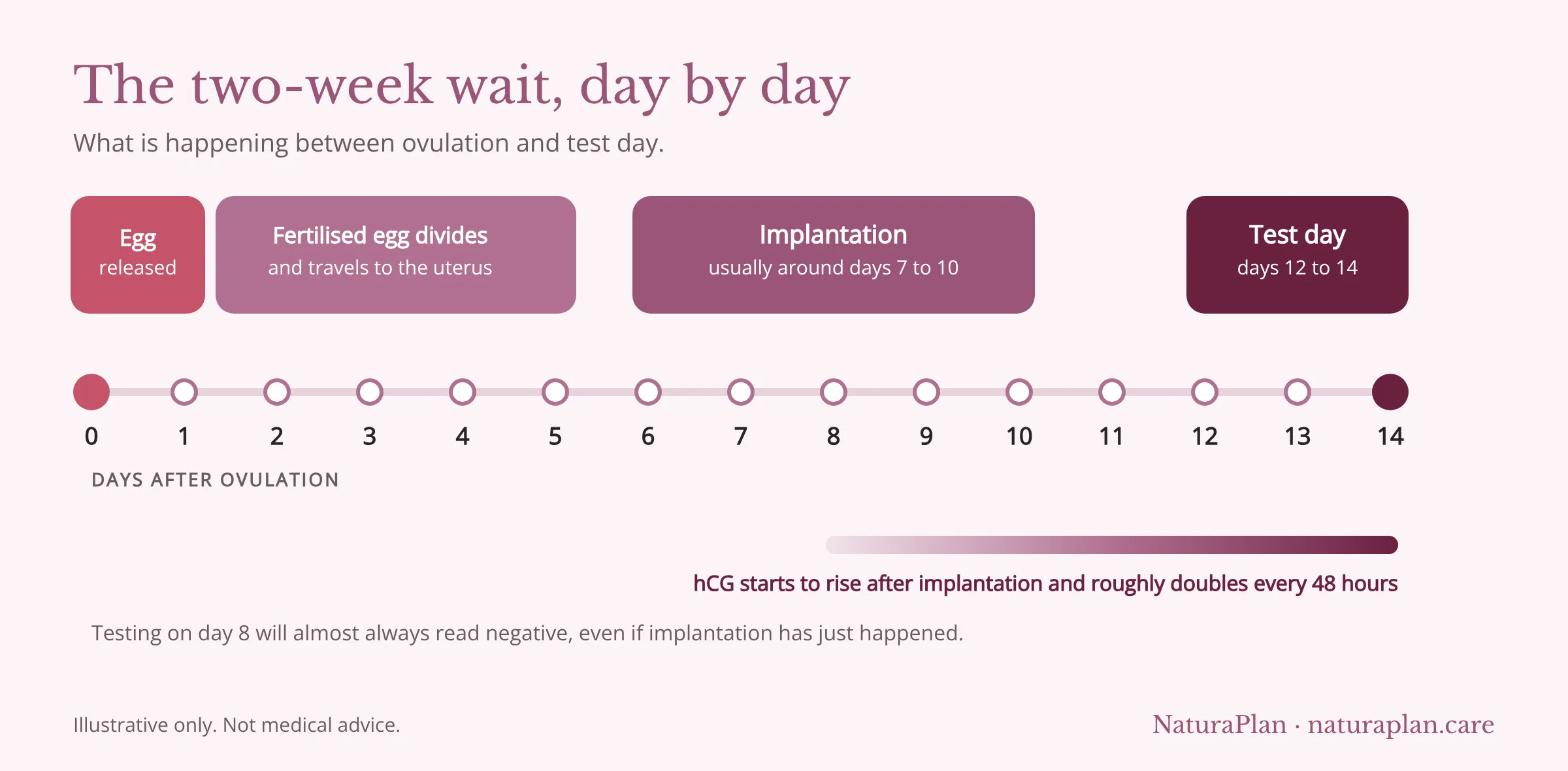 What happens between ovulation and test day.
Why Testing Too Early Produces False Negatives
Home pregnancy tests detect hCG above a threshold, typically 25 mIU/mL. Before hCG has risen to this level, a test will return negative even if implantation has occurred.
Testing on Day 8 post-ovulation, common in women experiencing early symptom anxiety, will almost always produce a negative result, not because conception did not occur, but because implantation may have only just happened and hCG has not yet accumulated to detectable levels. This negative test is genuinely uninformative, but it feels devastating.
Planned Parenthood’s guidance on pregnancy tests recommends waiting until the day of the missed period, which corresponds approximately to Day 14 post-ovulation, for the most reliable result.
When to Test
Earliest reliable test date: Day 12 post-ovulation, using a first-morning urine sample (most concentrated) and a sensitive test (10 mIU/mL threshold, such as First Response Early Result).
Standard test date: Day 14 post-ovulation, or the day of your expected period. This is the date at which most standard tests (25 mIU/mL threshold) reliably detect hCG.
If you test early and get a negative: Wait two to three days and test again. Do not rely on a single early negative.
NaturaPlan’s pregnancy test countdown begins after confirmed ovulation (three consecutive elevated temperatures) and counts down to your earliest reliable test date based on your personal average luteal phase length from previous cycles.
BBT During the Two-Week Wait
Your BBT remains elevated throughout the luteal phase. Progesterone keeps temperatures above the coverline until the corpus luteum breaks down before your period. A temperature that drops to pre-ovulatory levels signals that your period is approaching.
A BBT that remains elevated beyond Day 18 post-ovulation, significantly longer than your typical luteal phase, is a strong indicator of pregnancy. Many women notice this before they test.
Tracking your first three cycles and timing intercourse for conception.
Sources
- Wilcox AJ et al. (1999). Time of implantation of the conceptus and loss of pregnancy. NEJM, 340(23), 1796–1799.
- Planned Parenthood. (2023). Pregnancy tests. https://www.plannedparenthood.org/learn/pregnancy/pregnancy-tests
- Mayo Clinic. (2023). Home pregnancy tests: Can you trust the results? https://www.mayoclinic.org/healthy-lifestyle/getting-pregnant/in-depth/home-pregnancy-tests/art-20047940
NaturaPlan counts down your two-week wait
NaturaPlan starts your pregnancy test countdown the moment ovulation is confirmed. Know exactly when to test.