
The short answer is yes, but the number needs unpacking. The 99.4% figure that circulates about the sympto-thermal method is real and comes from peer-reviewed research, but it describes perfect use, not the average experience. Typical use lands closer to 98%. Both numbers are defensible, they just answer different questions, and anyone quoting one without the other is only telling you half the story.
Here’s exactly where 99.4% comes from, what the studies measured, how the sympto-thermal method compares to the pill, and what the honest caveats are.
Where the 99.4% number comes from
The figure traces to a single, unusually rigorous study: Frank-Herrmann and colleagues, published in Human Reproduction in 2007. It followed 900 German women using the sympto-thermal method (the Sensiplan protocol) across 17,638 cycles, making it one of the largest prospective datasets on any fertility awareness method.
The study split its perfect-use group in two, according to what couples did during the fertile window. For couples who used a barrier method during the fertile days, the unintended pregnancy rate was 0.6 per 100 women over 13 cycles. Expressed as effectiveness, that’s 99.4%. For couples who abstained entirely during the fertile window, the rate was 0.4 per 100 women, or 99.6%.
We quote the 99.4% figure because it reflects what most couples actually do. Either way, the method itself, applied as designed, failed fewer than one time in 165 woman-years. That’s not a marketing figure. It’s a method failure rate from a large cohort, and it’s what puts the sympto-thermal method in the same conversation as hormonal contraception.
Worth noting what happened to the couples who had unprotected intercourse during the identified fertile days: the pregnancy rate jumped to 7.5 per 100 women. The charting wasn’t the weak point. What couples did with the information was.
Perfect use versus typical use, the distinction that changes everything
Every contraceptive method carries two numbers, and confusing them is the single biggest source of misinformation about fertility awareness.
Perfect use measures what happens when the method is applied exactly as intended, every cycle, without shortcuts. For the sympto-thermal method that means charting both signs daily, treating any ambiguous day as fertile, and either abstaining or using a barrier through the fertile window. This is the 99.4% number.
Typical use measures what actually happens across real people, including the cycles where someone misreads a sign, takes a risk on a borderline day, or stops charting for a week. In the same body of research, typical-use effectiveness for the sympto-thermal method sits around 98%, meaning roughly 1.8 pregnancies per 100 women per year.
The gap between 98% and 99.4% isn’t the method failing. It’s human behaviour, and specifically what couples do on the days the chart flags as fertile. Follow the window and the method holds; ignore it and no method can help you. Our full guide to how the sympto-thermal method works walks through the daily rules that keep you in perfect-use territory.
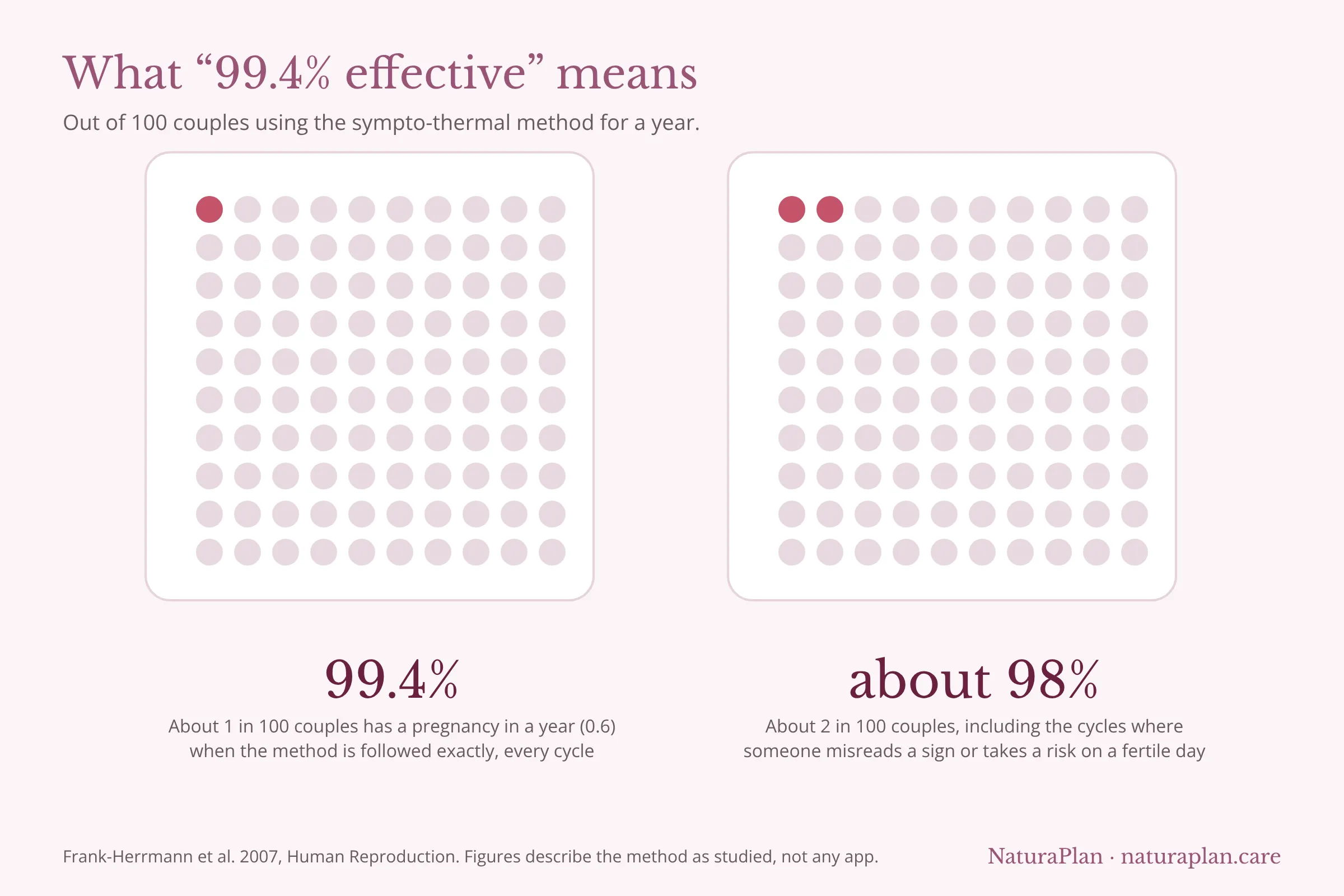 What the figures mean for 100 couples over a year, as the method was studied.
How it compares to the pill and other methods
Context matters, because “99% effective” means little without knowing what else scores similarly. James Trussell’s widely cited analysis of contraceptive failure rates in the United States gives the standard reference points: the combined pill runs about 0.3% failure in perfect use and 9% in typical use; male condoms, 2% and 18%.
Line those up against the sympto-thermal method’s 0.6% perfect use and roughly 2% typical use, and something interesting emerges. Well-practised sympto-thermal use sits close to the pill on perfect use, and its typical-use figure holds up far better than the condom’s, because the method’s built-in redundancy (two signs that must agree) is forgiving of the odd error in a way a single-barrier method isn’t.
The caveat is that this applies to the sympto-thermal method specifically, not to fertility awareness as a category. A 2018 systematic review in Obstetrics & Gynecology led by Peragallo Urrutia looked across all fertility awareness-based methods and found first-year typical-use pregnancy rates ranging enormously, from around 2% to 34% depending on the method. Calendar-based approaches sat at the weak end; double-sign symptothermal methods at the strong end. Lumping them together, as a lot of coverage does, produces a misleadingly pessimistic average. The method you choose matters more than the category, which is the point of our side-by-side comparison of the methods.
Charting both signs makes the perfect-use habits easier to keep.
NaturaPlan helps you learn the sympto-thermal method and chart both signs side by side. It’s a charting and education tool, not a contraceptive. It’s free for 14 days, needs no card to start, and keeps your data on your device. Try NaturaPlan free →
What the critics get right
An honest case has to include the objections, and there are legitimate ones.
First, the strong studies used trained instruction. The women in the Frank-Herrmann cohort were taught the method by certified instructors and supported through their learning cycles. Whether a woman teaching herself from an app achieves the same numbers is a fair question, and the research can’t fully answer it yet. This is exactly why the 2018 systematic review called for higher-quality studies: the evidence base, while promising, is smaller and more variable than the evidence base for hormonal methods.
Second, typical-use figures assume you’ll sometimes get it wrong. If your cycles are irregular, if you sleep erratically, or if you’re not yet fluent in reading your signs, your personal typical-use rate in the early months may be worse than the study average. Effectiveness climbs with experience, which is why the first few cycles deserve patience rather than reliance. We’re upfront about that ramp-up in our piece on how reliable natural family planning actually is.
Third, no method is 100%. Perfect use of the sympto-thermal method still means roughly 1 pregnancy per 165 women per year. That’s a real, if small, number, and it deserves honest weighting against how much an unplanned pregnancy would affect your life.
What moves you from 98% to 99.4%
The difference between typical and perfect use comes down to a few concrete habits. Chart both signs every cycle rather than relying on one. Treat any day you’re unsure about as fertile rather than safe, because the cost of a wrong “safe” call is far higher than a wrong “fertile” one. Wait for both signs to confirm the window has closed before treating days as infertile again. And during the fertile window, either abstain or use a barrier consistently, since that window is where every failure in the data actually occurred.
None of this is complicated, but it is consistent, and consistency is the entire ballgame. The women hitting 99.4% aren’t doing anything cleverer than the women at 98%; they’re just applying the rules the same way every cycle. Charting helps here, because it puts both signs side by side.
The bottom line
Is the sympto-thermal method really 99.4% effective? Used exactly as designed, yes, and that claim rests on one of the better contraceptive-effectiveness studies in the literature. Used the way real people use things, expect around 98%, which is still strong and still comparable to mainstream methods. The honest version of the sentence is: the sympto-thermal method is up to 99.4% effective with perfect use and about 98% effective in typical use, and the distance between those numbers is under your control.
That’s a better deal than the “unreliable natural method” framing suggests, and a more demanding one than “99% effective, no effort” implies. If you want to understand the full picture of hormone-free options before deciding, our overview of natural birth control methods puts this in context, and if you’re new to the whole approach, start with what natural family planning is and how it works.
Two ways to take the next step:
📱 Try NaturaPlan free — learn and chart the sympto-thermal method privately, in your browser.
📖 Get The Natural Cycle — our full evidence-based handbook, free with your email.
This article is for education, not medical advice. Effectiveness depends heavily on correct, consistent use and on your individual circumstances. Discuss your contraceptive choices with a clinician who knows your history.
Sources: Frank-Herrmann et al., Human Reproduction (2007); Peragallo Urrutia et al., Obstetrics & Gynecology (2018); Trussell, contraceptive failure in the United States (2011); American College of Obstetricians and Gynecologists, Fertility Awareness-Based Methods.